
Many customers who previously used BCS find, after switching to Group Reporting, that some features are automated differently or are no longer available out of the box. One example of this is the scheduled amortization of goodwill.
Pursuant to Section 301(3), first sentence, of the German Commercial Code (HGB), the remaining difference must be recognized as goodwill under assets. Section 253(3), sentences 3 and 4, of the German Commercial Code (HGB) provides that if the useful life of the goodwill cannot be reliably estimated, amortization must be calculated over 10 years.
In BCS, scheduled amortization of goodwill can be performed automatically using supplementary reporting data. Group Reporting does not offer this functionality, as it is structured in accordance with IFRS accounting standards. Under IFRS, there is no straight-line amortization; instead, goodwill is written down on an extraordinary basis following an impairment test (IAS 36).
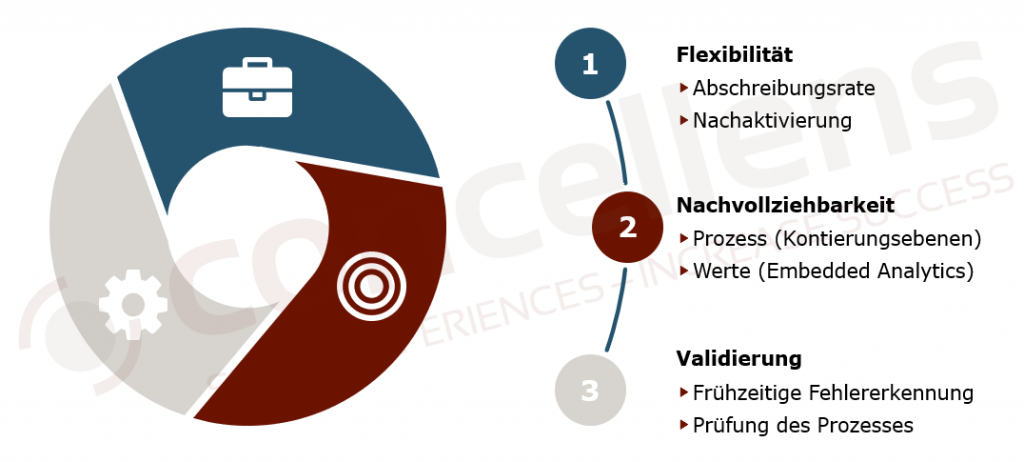
To address this, we have designed a solution for automatic amortization as part of our con-Lab within the Group Reporting Standards, using reclassifications and validations. The capitalized and already amortized difference is recorded in statistical accounts, ensuring traceability of the amortization process. A percentage for periodic or annual amortization must be entered manually. This ensures that, even in the event of a subsequent capitalization, the goodwill can be amortized over a shorter period. Even in the event of a system migration to Group Reporting, this allows goodwill to continue being amortized. Validation rules check whether the amount has been fully amortized or whether the amortization has eliminated too much.
By and large, we can conclude that depreciation—with the exception of entering the percentage—can be implemented in Group Reporting in a largely automated manner. Our approach offers the necessary flexibility in the event of a subsequent capitalization, as well as sufficient traceability and validation within the depreciation process.