
Implementing or modernizing a consolidation solution is one of the most strategically important decisions in the finance department. It not only affects the Many corporations are currently facing a pivotal decision: What should their future consolidation architecture look like?
In particular, companies that are still using SAP® SEM-BCS today need to address this issue promptly. This is because the end of support for SAP® BW 7.5—and thus for many existing SEM-BCS installations—is fast approaching. At the same time, SAP is clearly shifting its strategic target architecture toward SAP S/4HANA for group reporting, the Business Data Cloud, and AI-powered processes.
For CFOs, heads of corporate accounting, and IT decision-makers, this is not just a technical issue regarding the system. Rather, the key factor is:
Which solution reliably supports the consolidated financial statement process today—and is also future-proof enough to meet tomorrow’s requirements?
1) The need for action is growing: SEM-BCS is coming to an end
Many companies have been working successfully with SAP SEM-BCS for years. The solution is proven, the processes are well-established, and the risk of failure is low. Reporting data is often automatically imported from source systems or provided via file uploads. In many cases, reporting is done using Analysis for Office.
That is precisely why SEM-BCS remains a stable component of the financial closing process in many corporations.
At the same time, strategic and economic challenges are increasingly emerging. SAP is no longer actively developing SEM-BCS. Many BW environments have already been modernized or transformed to SAP Analytics Cloud, Datasphere, or BW/4HANA. As a result, SEM-BCS often remains as the last application in an older BW environment—with rising operating, integration, and maintenance costs.
Added to this is the maintenance timeline: Mainstream maintenance for SAP BW 7.5 is generally available through the end of 2027. Extended maintenance or certain cloud scenarios can extend this timeline through 2030. However, this does not replace a long-term strategic decision. BCS/4HANA, on the other hand, offers a long-term outlook through 2040, provided the underlying architecture is kept up to date.
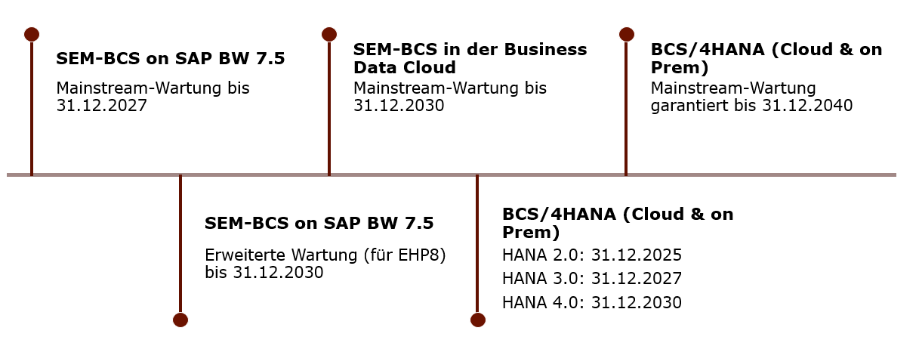
Figure 1: Maintenance Horizon for SEM-BCS and BCS/4HANA
SEM-BCS's maintenance timeline makes it clear: Companies should evaluate their target architecture now, rather than waiting until shortly before maintenance expires to take action.
For decision-makers, this means that anyone still using SEM-BCS today should not wait until just before maintenance support expires to take action. The real question is not whether a change is necessary—but which path is the right one from a functional, technical, and economic standpoint.
2) Two possible approaches: Group Reporting or BCS/4HANA
Essentially, many companies are faced with two options.
SAP S/4HANA for Group Reporting is SAP's strategic consolidation solution. New developments, modern integration scenarios, shorter release cycles, and—in the future—AI capabilities will primarily be implemented in this solution.
BCS/4HANA, on the other hand, is the obvious successor solution for companies that want to largely retain their existing BCS model. This refers to BW/4HANA with the corresponding consolidation add-on. The solution can be particularly useful when existing processes are running smoothly, complex consolidation logic needs to be preserved, and the focus is on continuity.
Therefore, this decision cannot be made across the board. It depends heavily on how complex the current closing process is, how well SEM-BCS is currently functioning, what business requirements exist, and what strategic SAP architecture the company is pursuing.
3) When is SAP S/4HANA a good choice for group reporting?
Group reporting is particularly appealing when companies want to realign their consolidated financial statement process.
The solution is directly integrated into SAP S/4HANA, enabling a closer connection between operational accounting, the Universal Journal, and consolidation. For companies already using S/4HANA, this can be a major advantage: data can be analyzed closer to its source, discrepancies can be traced more quickly, and the record-to-report process is more tightly integrated.
SAP also offers a dedicated solution for non-SAP companies or companies outside the central S/4HANA system in the form of the Group Reporting Data Collection App. There, reporting data can be entered, mappings maintained, and additional information such as notes, ESG data, or comments integrated.
Group Reporting is particularly well-suited for companies that want to integrate their consolidation more closely with S/4HANA, rethink and standardize their processes, and actively leverage SAP’s cloud, data, and AI strategies.
The key point: Group Reporting is not just a new consolidation tool, but part of a broader SAP target architecture. It is closely linked to areas such as the Business Data Cloud, Enterprise Performance Management, Intercompany Matching, SAC, and, in the future, AI-driven processes.
For companies that are already facing an S/4HANA transformation or a fundamental realignment of their finance department, Group Reporting can therefore be the logical path forward. Data reliability.
4) When might BCS/4HANA be the better choice?
BCS/4HANA can be particularly useful if the existing SEM-BCS system is working very well and the focus is on stability, continuity, and risk minimization.
Many corporations have spent years building highly specialized consolidation processes in BCS. The system is well-established, the speed of financial closing is adequate, and in-house developments and rulesets are in place. In such cases, the question arises as to whether a complete rebuild would actually deliver the desired added value—or whether a brownfield approach based on BCS/4HANA makes more sense from both a business and technical perspective.
A key advantage: Depending on the conversion scenario, existing processes, historical transaction data, Customizing settings, and in-house developments can largely be retained. As a result, the scope of the project is often smaller than that of a complete greenfield implementation of Group Reporting.
BCS/4HANA may be of particular interest to companies that are generally satisfied with their current SEM-BCS process, are looking for a fast and low-risk transformation path, wish to preserve extensive historical data and existing structures, or have complex special requirements for their consolidated financial statements.
In addition, there are technical differentiators where BCS/4HANA may still have advantages at this time.
This includes, in particular, the automated elimination of intercompany results in fixed assets. For corporate groups with regular intra-group asset sales, this can be a decisive factor. BCS/4HANA can automatically capitalize intra-group asset sales and systematically map adjusted asset histories, including depreciation updates.
BCS/4HANA can still offer advantages today, even when it comes to scheduled goodwill amortization under the German Commercial Code (HGB) and true matrix consolidation across multiple dimensions. This point should be carefully evaluated, particularly for complex corporate structures with sophisticated legal and management perspectives.
5) A Comparison of Two Target Architectures
The decision between Group Reporting and BCS/4HANA is also an architectural decision.
Group Reporting is deeply integrated into SAP S/4HANA. The operational data foundation, the Universal Journal, the Consolidation Journal, and supplementary components such as the Data Collection App, Business Data Cloud, SAP Analytics Cloud, and Datasphere are all interconnected within a target architecture.
BCS/4HANA follows a different approach. Consolidation remains anchored in the BW/4HANA environment. Data is extracted from source systems, transformed, and processed in analytical data models. This can be an advantage for companies with established, stable BW and BCS structures—especially if existing consolidation logic is to be retained.

Figure 2: Possible Target Architecture in the Context of SAP Group Reporting

Figure 3: Possible Target Architecture in the Context of BCS/4HANA
Group Reporting and BCS/4HANA represent two different target architectures: integrated consolidation in S/4HANA versus proven consolidation in the BW/4HANA environment.
It is precisely this architectural distinction that is crucial for decision-makers. Companies that consistently pursue an integrated S/4HANA, cloud, and data strategy in the coming years will view group reporting differently than companies whose existing BCS process is highly automated, stable, and functionally mature.
6) Greenfield or Brownfield: The Real Question Behind the Project
The choice of tools is closely linked to the project strategy.
A greenfield approach means that processes are reimagined from both a business and technical perspective. Existing structures are not simply carried over, but are reevaluated based on future requirements, SAP best practices, and new technological capabilities. This approach is particularly well-suited to SAP S/4HANA for Group Reporting.
The advantage lies in future-proofing. Companies can restructure their consolidation processes, standardize them more effectively, and leverage modern SAP architectures. However, the effort involved is greater: requirements must be analyzed, processes redefined, historical data prepared, and users closely involved.
A brownfield approach has a different goal: The existing system is transformed and migrated to BCS/4HANA. The focus is on continuity, minimal change, and risk minimization. This approach is particularly attractive if SEM-BCS is currently running stably and the closing process is not to be fundamentally changed.
The choice of target system is closely linked to the project strategy: Brownfield stands for continuity and risk minimization, while Greenfield stands for realignment, standardization, and future-readiness.
There are various scenarios for converting to BCS/4HANA. In an in-place conversion, the existing system is converted directly. The goal is to preserve historical data, Customizing settings, and in-house developments as much as possible. In contrast, there are remote or shell conversion scenarios in which a new target system is set up in parallel. The existing SEM-BCS system can continue to run during this process, which safeguards the ongoing closing process.
When migrating to Group Reporting, however, an initial technical setup is typically required. In practice, the most recent audited financial statements are often prepared as CSV or Excel files and imported into the new system. Further consolidation is then performed in the new Group Reporting system based on this data.
7) The decision is not purely an IT issue
It is important for corporate decision-makers to note that the choice between BCS/4HANA and Group Reporting should not be made solely from a technical perspective.
The relevant questions are, rather:
- What demands do our consolidated financial statements place on automation, transparency, and speed today?
- Which processes work very well in the existing system—and which ones should be deliberately rethought?
- What is the significance of specialized topics such as the elimination of intercompany results in fixed assets, goodwill amortization under the German Commercial Code (HGB), or matrix consolidation?
- To what extent is our future finance architecture already geared toward S/4HANA and the Business Data Cloud, particularly the Datasphere and the SAP Analytics Cloud?
- How much change can and is the organization currently willing to accommodate in the closing process?
- And last but not least: How much time is realistically available for analysis, decision-making, implementation, testing, migration, and go-live?
This last point, in particular, is often underestimated. A greenfield implementation of Group Reporting can—depending on scope, resources, and complexity—quickly turn into a project lasting one to two years. A brownfield conversion to BCS/4HANA can be faster and involve less risk, but it also requires a thorough analysis of the existing system landscape, in-house developments, data models, and processes. Consistent elimination of intercompany profits in fixed assets, including automatic depreciation updates, can be a decisive selection criterion in this context. It reduces manual intervention, improves data quality, and lays the foundation for transparent, audit-compliant, and efficient consolidated financial statements.
Conclusion: The right decision depends on the desired outcome
SAP S/4HANA for Group Reporting is SAP's strategic solution for the future. Any organization looking to realign its consolidation processes, achieve greater integration, and benefit from innovations, cloud architectures, and AI-powered processes in the long term should seriously consider this approach.
However, BCS/4HANA remains a highly relevant option for companies that operate a proven SEM-BCS system with a high level of process maturity and are primarily seeking stability, continuity, and investment security. Especially when it comes to complex, specialized requirements in consolidated financial statements, BCS/4HANA may still be the more suitable technical solution at this time.
The crucial question, therefore, is not:
Which tool is better?
Rather:
Which solution best fits your consolidation strategy—today, during the transformation, and in the future SAP target architecture?
Companies that address this issue early on can ensure planning certainty, reduce project risks, and safeguard the future viability of their consolidated financial statements.