
Which consolidation solution is right for you?
Many companies are currently examining how they can make their SAP consolidation future-proof. The requirements for consolidated financial statements and group consolidation are increasing. Greater speed, transparency, ESG reporting, data quality and automation are becoming increasingly important. At the same time, the SAP system world is changing fundamentally.
In many companies, older solutions such as EC-CS (Enterprise Controlling - Consolidation System), SEM-BCS (Strategic Enterprise Management - Business Consolidation System) or SAP BPC (Business Planning and Consolidation) are still doing their job. Modern BW-based approaches such as BW/4HANA or BCS/4HANA also remain relevant - especially where complex corporate structures, multi-layered data models or widely branched organizational networks require maximum flexibility.
At the same time, SAP is clearly shifting its strategic development towards SAP S/4HANA Finance for Group Reporting (further referred to as SAP Group Reporting). This solution no longer views consolidation as a parallel process, but as an integral part of the overall financial architecture. This creates a new generation of closing processes in which data, systems and control logic are more closely interlinked than ever before.
1) Why older consolidation systems continue to be used - and where their limits lie
Many companies continue to use EC-CS, SEM-BCS or SAP BPC because these systems have enabled stable, transparent and mature processes for years.
SAP EC-CS is firmly anchored in classic SAP ERP and will provide a robust basis for Group consolidation until the end of 2027.
SEM-BCS is located in the SAP Business Warehouse (BW) and impresses with its high level of consistency, extensive logging and strong modeling capability. SEM-BCS therefore remains a solid solution for companies with extremely complex structures, frequent reorganizations or high reporting requirements.
SAP BPC has long been attractive because it combines planning and consolidation in a common BW-based platform. This is particularly helpful for companies that operate closely integrated financial planning. This logic also lives on in the BW/4HANA environment: BPC functions can still be used to implement sophisticated planning or consolidation models that require a high degree of flexibility and calculation logic.
With BCS/4HANA SAP provides a modernized consolidation solution for BW/4HANA. This is particularly suitable for companies whose group structures are very dynamic and whose subsidiaries are frequently reorganized, merged or restructured. In such cases, BW-based modeling offers flexibility that continues to give some companies an advantage.
Despite all these strengths, however, these systems have one thing in common: they exist outside of operational accounting and are therefore dependent on extractions, transformations and manual reconciliations. This architectural approach no longer corresponds to the way modern financial organizations work, which relies on real-time data, automation and direct process integration.
2) Why SAP S/4HANA Finance for Group Reporting goes one step further technologically
SAP S/4HANA Finance for Group Reporting differs fundamentally from previous consolidation solutions. Consolidation works directly on the Universal Journal (ACDOCA and ACDOCU). This means that consolidation is no longer treated as a separate data and process strand, but is based on the same data that is used for operational accounting. This improves data quality, as transformation and reconciliation steps are no longer necessary and consolidation-relevant facts are seamlessly derived from operational accounting.
For CFOs, this means no parallel data budgets and a consistent data landscape. This creates transparency, accelerates financial statements and significantly reduces the effort required for manual error corrections. At the same time, a system architecture is created that is both more stable and more future-proof, as it relies on modern in-memory technology and automated processes.
3) How SAP Group Reporting standardizes, automates and strategically strengthens the closing process
The biggest advantage of SAP S/4HANA Finance for Group Reporting is the end-to-end integration of all steps in the closing process. The solution combines individual financial statements, intercompany reconciliation, consolidation, validation and reporting in a single line. Media disruptions and duplicate data storage are significantly reduced.
A particularly effective component of this integrated approach is the connection to the Group Reporting Data Collection (GRDC). Companies use the GRDC to collect data from all subsidiaries - regardless of the respective system landscape. The process is workflow-supported and validates the data in a structured manner. This standardized data collection creates a high level of process clarity. It ensures that the consolidation data is complete and quality-assured before it is processed.
Navigation has also been optimized: Users can now jump directly from rule maintenance to professionally and technically related applications without having to laboriously navigate through several menu items. One of the most effective new features is the extended where-used list, which shows transparently where rules, variables, filters and rule groups are used. This improves governance and allows adjustments to be made much more securely.
The Intercompany Matching & Reconciliation (ICMR) function complements this logic by reconciling intercompany transactions in real time and disclosing discrepancies at an early stage. As a result, most clarifications are already made in the monthly process - this reduces last-minute reconciliations and relieves the burden on the consolidated financial statements. SAP Group Reporting creates a closing process that is significantly more automated, standardized and transparent than any previous SAP solution.
With the increasing use of AI-supported functions, such as the SAP co-pilot Joule, analyses and queries become more interactive and faster. In addition, rule-based consolidation logic ensures that complex eliminations or transfers are carried out automatically and transparently. The overall result is a closing process that is more standardized and automated than in classic SAP landscapes.
4) Why integration with the SAP Analytics Cloud (SAC) represents a paradigm shift
Another strength of SAP Group Reporting is its deep integration with SAP Analytics Cloud (SAC). This integration allows companies to analyze consolidated actual data directly and simultaneously incorporate planning, forecast or simulation results in the same data context.
While older BW-based solutions such as SEM-BCS, BCS/4HANA or SAP BPC have powerful planning and modeling functions, these functions remain trapped in a separate data world. SAP Group Reporting brings planning and consolidation data together in a common data model. This means that plan consolidations and strategic scenarios can be created directly on the same basis that is used for the actual financial statements.
This creates an integrated management platform on which CFOs can not only carry out retrospective analyses, but also model future-oriented decisions - whether in the context of M&A simulations, investment scenarios or currency model effects.
5) The SAP Business Data Cloud: Paving the way for integrated and future-oriented financial management
The SAP Business Data Cloud (BDC) marks a new stage of development for the financial and consolidation architecture.
SAP S/4HANA Finance for Group Reporting already combines operational and consolidated financial statements on a common database. The Business Data Cloud expands this approach and connects different systems, domains and applications. In future, financial data from SAP Group Reporting can be combined more closely with non-financial information, ESG key figures, operational performance data or external data sources. The governance of the central financial data remains intact.
This creates a company-wide, standardized data platform for CFOs. Consolidation is no longer just used as a closing tool, but forms the basis for analyses, simulations and AI-supported decisions throughout the company. In the long term, the Business Data Cloud (BDC) can link the areas of Group reporting, analytics, planning and strategic management even more closely together. The consolidated financial statements are thus evolving from a pure reporting obligation into a genuine central basis for corporate management.
6) When companies should continue to rely on SEM-BCS, SAP BPC or BCS/4HANA - and when they should not
Despite SAP's strategic focus on Group Reporting, there are scenarios in which BW-based consolidation or planning solutions continue to make sense.
SEM-BCS shows its strengths above all in group structures that are very dynamic, have frequent organizational changes or require particularly complex segmentation and movement logic. In such cases, the BW-based architecture offers a high degree of flexibility, which can still be advantageous for certain company sizes or industries.
SAP BPC remains relevant in companies that cannot yet switch to SAP Analytics Cloud or where the integration of extensive planning processes is deeply rooted in the BW system. BPC can also continue to be used in the BW/4HANA environment if companies are in a transitional model or if the existing planning architecture would make a short-term transformation difficult.
BCS/4HANA as a modernized BW/4HANA variant is particularly suitable for companies with very complex corporate networks and frequent structural changes. In such cases, the BW-based flexibility offers advantages that Group Reporting does not offer to the same extent in its S/4HANA-centric architecture.
In the long term, however, companies should be aware of this: SAP is driving innovation and strategic developments much more strongly in the Group Reporting environment. BW-based solutions will continue to remain stable and useful for certain use cases. However, SAP Group Reporting is increasingly forming the target architecture for the future SAP consolidation landscape.
With the SAP Business Data Cloud, a further evolutionary stage of the financial and consolidation architecture is on the horizon.
While SAP S/4HANA Finance for Group Reporting already combines operational and consolidated financial statements on a common database, the Business Data Cloud extends this logic across systems, domains and applications. In future, financial data from Group Reporting can be linked more closely with non-financial information, ESG key figures, operational performance data or external data sources - without losing the governance of the core data.
For CFOs, this opens up the prospect of a company-wide, semantically consistent data platform on which consolidation is not just a closing tool, but the starting point for analyses, simulations and AI-supported decisions. In the long term, the Business Data Cloud can become the connecting layer that more closely interlinks Group reporting, analytics, planning and strategic management and transforms the consolidated financial statements from a purely mandatory reporting process to a central management basis.
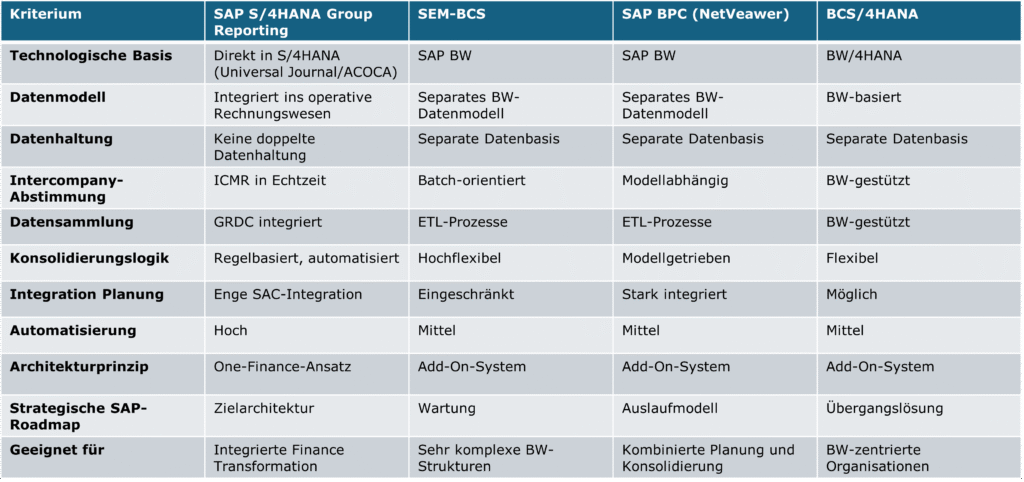
SAP consolidation software in comparison:
Conclusion: SAP Group Reporting is the strategic future
SAP S/4HANA Finance for Group Reporting combines the advantages of a harmonized database, a fully integrated closing process, strong automation and a close link between consolidation, reporting and planning.
Consolidation solutions such as EC-CS, SEM-BCS, SAP BPC and even BCS/4HANA remain relevant in certain use cases - especially for very complex group structures or strongly BW-oriented architectures. For most companies, however, SAP Group Reporting is the strategic target architecture for group consolidation. For CFOs, this means that they must pragmatically weigh up short-term operational security against long-term financial transformation - but at the same time clearly recognize that the path to integrated consolidation, automated processes and sustainable control capability leads via SAP S/4HANA Finance for Group Reporting.
Are you facing a strategic decision in your group consolidation?
Whether transformation to SAP S/4HANA Finance for Group Reporting, further development of existing BW-based solutions or the definition of a sustainable target architecture - setting the right course determines the efficiency, transparency and future viability of your finance organization. In our free initial consultation, we analyze your current system landscape together, evaluate options for action and show you a clear strategic roadmap for your group consolidation.
Our Strategy consulting for group consolidation combines technical expertise, SAP architecture know-how and many years of project experience - independent, practical and tailored to your specific situation.
Arrange your no-obligation initial consultation now and create clarity for your future financial architecture.