
What is SAP Group Reporting Data Collection (GRDC)?
SAP Group Reporting Data Collection (GRDC) is the central cloud solution for data collection and integration as part of group consolidation. As an extension to SAP S/4HANA for Group Reporting public/private cloud, GRDC enables companies to efficiently collect and validate data from different sources and automatically integrate it into the consolidation process.
Especially for CFOs, group accounting teams and those responsible for consolidation, GRDC is a crucial tool for ensuring transparency, data quality and speed in financial reporting.
Before we dive into the three components of GRDC, it is worth taking a look at the challenges that this solution addresses.
Challenges in the Group environment that GRDC solves
Many companies face similar structural problems in data collection. Different source systems, partly manual processes and a lack of automation characterize everyday life.
Typical challenges include:
- Heterogeneous data sources in international corporations
- High manual effort in data collection
- Lack of automation in transformation, harmonization and validation
- Lack of data quality
GRDC offers an integrated solution for this with the Forms, Data Mapping and Packages modules.
Forms - The basis for structured data capture
Forms are at the heart of data entry in GRDC. They serve as an intuitive, centrally managed interface that subsidiaries and specialist departments can use to enter or correct financial data in a structured manner. The forms can be fully adapted to the specific requirements of a group.
forms are not only used for classic actual data, but also for additional reporting data, disclosures in the notes or information for sustainability reporting.
Practical example: Validation directly in the recording process
In practice, subsidiaries receive form layouts in a standardized design. One highlight is the implemented visual validations: If the system detects a balance sheet that is not balanced, for example, this is immediately visible - even before data is sent. For example, it is immediately apparent that the balance sheet has not been balanced.
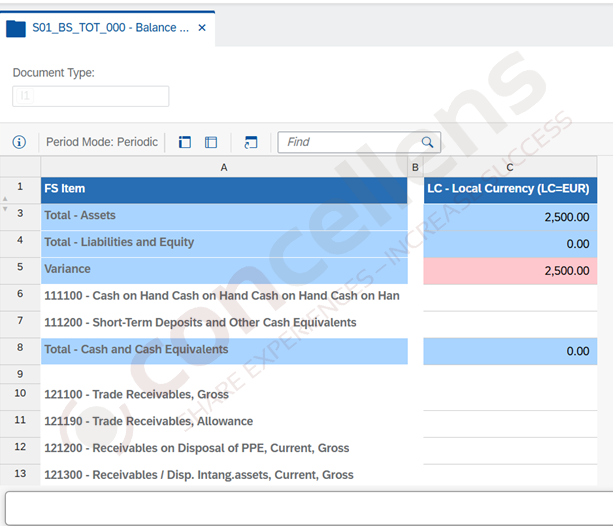
Figure. 1: Example of a form for entering closing balances in the balance sheet with visual validation
Thanks to real-time integration, recorded data is immediately available for further checks or processing steps in Group Reporting.
Functions of the forms
In addition to their function as a data entry interface, forms contain a number of other useful features. Companies can enter their actual data directly, make corrections in a comprehensible manner and add explanatory comments via Notes fields. Special ZMD/KapKo forms are also available for capital and group interrelationships, which are precisely tailored to these requirements.
Advantages for the practice
The use of Forms brings tangible benefits: a uniform interface for all companies reduces training costs and error rates. Integrated checks and the direct connection to SAP Group Reporting significantly improve data quality and make the data collection process more efficient.
Data mapping - the bridge between source system and consolidation
Data mapping is the second central pillar of GRDC and forms the link between upstream systems and the consolidation process. It enables data from different sources to be converted into a standardized format suitable for SAP Group Reporting. This is particularly relevant for companies with diverse or historically grown system landscapes.
In terms of technical capabilities, GRDC supports a wide range of data sources, including:
- SAP ERP systems (e.g. SAP ECC)
- Non-SAP systems via API
- Flat files (export from the sources must be possible)
- Remote ACDOCA
- Own ACDOCA
- Own ACDOCU
- SAP DataSphere (coming soon)
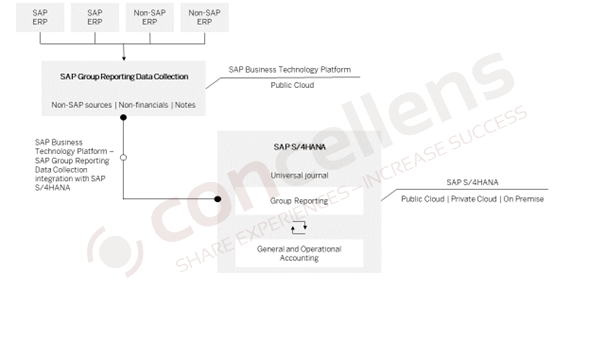
Figure 2: SAP architecture overview
How data mapping works
The core of the mapping is a flexibly configurable mapping file. Simple 1:1 assignments - such as from G/L accounts to consolidation items - can be implemented as well as more complex derivations. These can, for example, derive a business unit depending on the company code and segment.
| A | B | C | D |
| I | I | O | |
| Level | CompanyCode | Segment | ConsolidationUnit |
| Alias | |||
| 0 | C1 | S1 | CU11 |
| C1 | S2 | CU12 | |
| C1 | S3 | CU13 | |
| C2 | S1 | CU21 | |
| C2 | S2 | CU22 |
Table 1: Derivation of the consolidation unit depending on the company code and segment (source SAP: Use Cases | SAP Help Portal)
Practical example: Automated derivations and traceability
One major advantage is automation: recurring flat file creation and manual uploads are completely eliminated.
The logically defined derivations significantly reduce the potential for errors. Detailed traceability logs make it easy to trace the transformations, which not only helps considerably in testing but also in deviation analyses.
GRDC also offers the flexibility to quickly create a customized mapping in the event of changes to the system landscape - for example when purchasing a new subsidiary - and to integrate the new unit into the ongoing process.
Packages - The control center for data acquisition
While forms and data mapping fulfill specific functions, the packages form the logical bracket around the entire data collection process. They control which companies have to record or provide which data in which period and version.
Packages combine forms, data mappings, validation logics and the integrated data transfer from ACDOCA to create an end-to-end process.
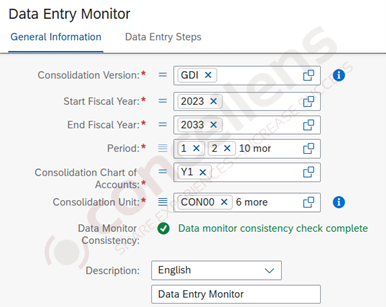
Figure 3: Selection of the framework parameters for the validity of data collection
Practical example: Flexible consideration of new requirements
For example, if a group requires additional financial statements for a foreign subgroup, these companies can be quickly assigned their own forms and parameters. Packages thus act as a central instance for granular and consistent control of the data capture process.
GRDC in the conforce methodology
In our conforce methodology GRDC plays an important role. It provides the basis for clearly structured, transparent and automated mapping of all data capture steps - from input to transformation and validation. Through the combination of granular validations, flexible control and a centralized process view, GRDC supports a modern and audit-proof consolidation process.
Would you like to see GRDC live in action?
In our compact 20-minute live demo, we will show you how forms, data mapping and packages interact and what added value GRDC can offer for your consolidated financial statements.
Demo content:
- Look & feel of the user interface
- Live examples from consolidation practice
- Insight into typical use cases
- Space for your questions
We look forward to presenting GRDC to you live and identifying potential for your processes together.
Request a non-binding demo appointment now: